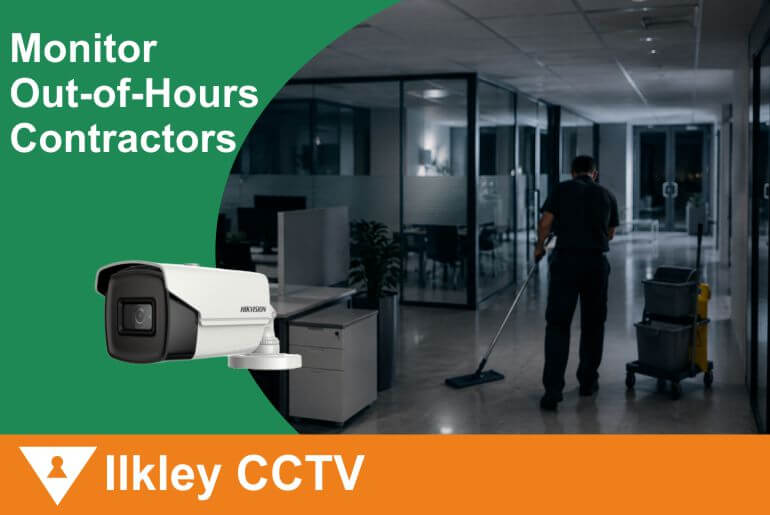
CCTV to monitor out-of-hours contractors –
For many businesses, the working day does not end when the last employee leaves. Cleaners arrive, maintenance engineers carry out repairs, contractors complete projects and delivery teams occasionally operate outside normal hours.
This creates a period when commercial premises may be occupied by people working largely unsupervised.
For businesses across Ilkley, professionally installed CCTV can provide valuable visibility during these quieter periods while supporting security, health and safety and effective facilities management.
Commercial cleaning is a good example. Many cleaners work early in the morning or late in the evening to avoid disrupting employees and customers. They may have keys, access codes or authorised entry to significant parts of the building.
CCTV can provide an independent record showing when contractors entered and left the premises without requiring managers to physically supervise routine visits.
The same applies to maintenance companies.
Air-conditioning engineers, electricians, plumbers and IT contractors may need to work when equipment can be safely shut down or when buildings are unoccupied. If an issue is discovered the following morning, CCTV can help establish which areas were accessed and when.
This is particularly useful when several contractors are working on the premises during the same period.
Imagine discovering that an internal door has been damaged overnight. The cleaner believes it was already damaged when they arrived, while a maintenance contractor says everything was intact when they left. Rather than relying on conflicting accounts, recorded footage may provide a clear timeline.
Security is another consideration.
Legitimate contractors may have access to entrances that are normally locked outside business hours. If a door is accidentally left unsecured, CCTV footage can help establish what happened and whether anyone subsequently entered the building.
Commercial surveillance can also support lone-working procedures. Where authorised personnel are working in isolated areas outside normal hours, appropriately positioned cameras can provide additional operational visibility. CCTV should not replace suitable lone-worker policies, but it can form part of a wider approach to managing premises safely.
Professional camera positioning is essential.
The objective should not be to monitor every movement an employee or contractor makes. Instead, cameras can concentrate on appropriate areas such as entrances, corridors, reception areas, stock access points and external approaches.
This provides useful evidence while keeping surveillance proportionate to the business requirement.
Modern CCTV systems make reviewing out-of-hours events significantly easier. High-definition recordings can be searched by authorised personnel, while suitable systems can provide secure remote viewing when managers need to check the premises without travelling to the site.
Access control integration can add further context. If a building uses electronic access systems, businesses may be able to compare entry information with relevant CCTV recordings to establish a clearer picture of activity around the premises.
Out-of-hours working arrangements should also be reviewed periodically.
A cleaning company may change its schedule, new contractors may be appointed or refurbishment work could result in tradespeople accessing areas that are normally restricted. The CCTV system should continue reflecting how the building is actually being used.
Responsible footage management remains important. Businesses should establish clear procedures covering who can access recordings and how CCTV is used. Contractors and employees should also be appropriately informed about surveillance within the premises.
For Ilkley businesses, the value of CCTV therefore extends well beyond traditional theft prevention.
During normal working hours, managers and employees naturally provide a degree of oversight simply by being present. Once the building becomes quiet, that visibility disappears even though commercial activity may continue.
A professionally designed CCTV system helps bridge that gap.
Whether confirming contractor attendance, investigating unexplained damage or reviewing an unusual out-of-hours event, recorded footage provides businesses with an objective source of information.
The question isn’t necessarily whether somebody should be on your premises after everyone has gone home.
It is whether, when something unexpected happens, you can establish exactly who was there and what occurred.